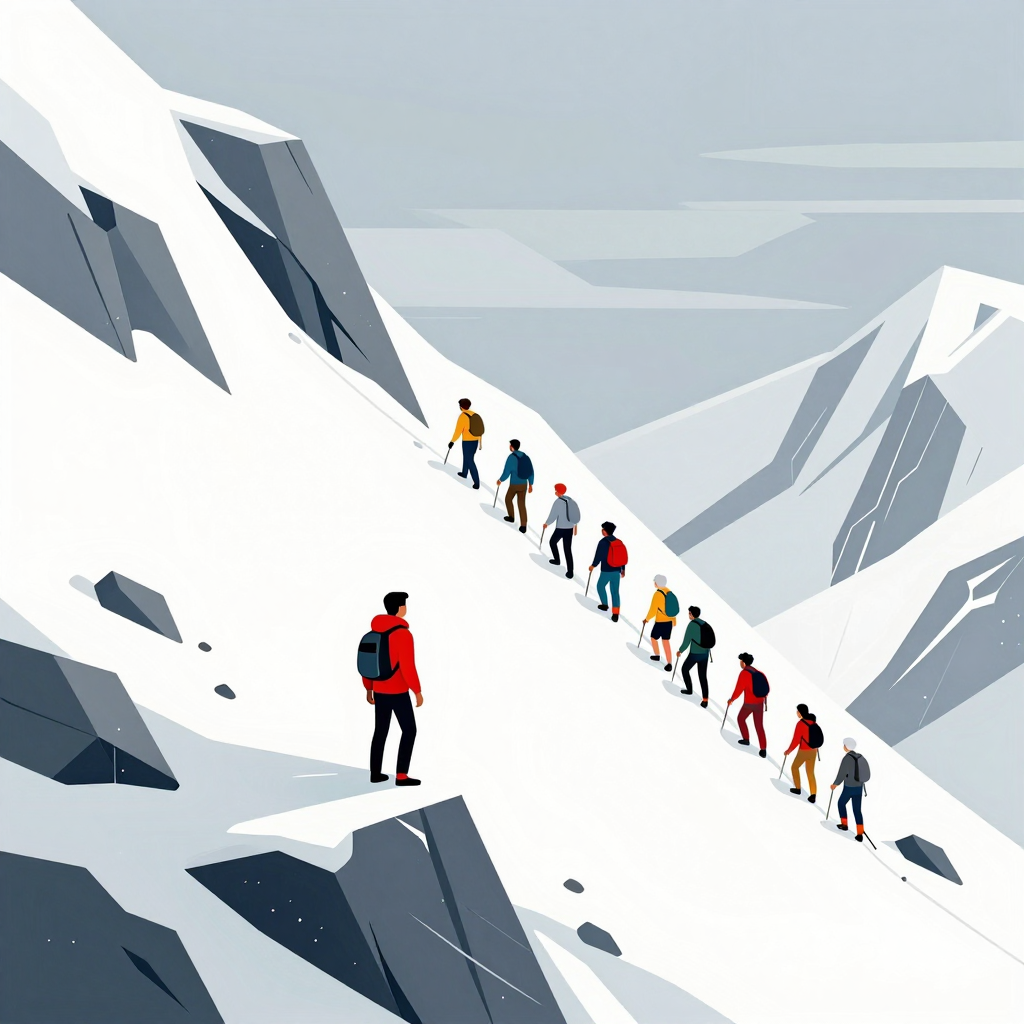
In mountaineering, reaching the top of a mountain is only the beginning of a long and often perilous journey back down. The descent, which can start with a sense of relief, can quickly turn into a life-threatening challenge. This is especially true at high altitudes, where the thin air and harsh conditions can lead to exhaustion, frostbite, and other serious injuries. Looking back at some of the most dangerous descents in the history of mountaineering, particularly in the 1950s, reveals the extreme risks climbers faced.
One of the most famous unsolved mysteries in mountaineering involves George Mallory and Sandy Irvine, who disappeared during their attempt to reach the summit of Everest on June 8, 1924. While it is unclear whether they reached the top, many believe that a fall during their descent—either before or after reaching the summit—led to their deaths. Without a survivor to provide details, the truth about their fate remains unknown.
In 1950, Louis Lachenal and Maurice Herzog made history by becoming the first to reach the summit of Annapurna on June 3, 1950. Herzog later described the climb in his book Annapurna, first 8000 (Arthaud, 1951), highlighting the immense determination required to reach such an extreme height. After taking photos at the summit, Lachenal began the descent while Herzog paused to take in the view. During the descent, Herzog lost his gloves, a critical problem at that altitude. He described the experience as disorienting, with time slipping away and difficulty breathing.
Lachenal rushed toward Camp 5, where two other climbers, Terray and Rébuffat, were waiting to help. As he approached, he slid and was recovered 150 meters below the camp. The group brought him back to the tent, where they found Rébuffat and Herzog with frostbitten hands. All night, Terray and Rébuffat tried to warm their extremities but were too late. The next morning, the group got lost in the fog and spent another night in a crevasse. By dawn, Terray was suffering from snow blindness, while Lachenal and Herzog were frozen, and Rébuffat was at the end of his rope. Their situation seemed hopeless until Marcel Schatz arrived to rescue them. A few hours later, the four injured climbers, supported by Sherpas, reached Camp 2, where Doctor Oudot evaluated their injuries.
Four years later, six French climbers attempted the first ascent of Aconcagua via the south face. Pierre Lesueur, Edmond Denis, Guy Poulet, Adrien Dagory, Lucien Bérardini, and Robert Paragot reached the summit on February 25, 1954. However, their descent was filled with danger. Dagory and Lesueur disappeared during the descent, while the others reached the Juan Peron refuge, where they found fuel to make water. The next morning, military personnel rescued them and informed them that Dagory and Lesueur had reached Punta del Inca village, where the expedition leader, René Ferlet, was waiting. All but Robert Paragot suffered serious amputations, with Bérardini losing part of his left hand.
Tragic Descents in 1950s Mountaineering Highlight Risks of High-Altitude Climbs
AI-rewritten from original reportingHow it works

mountaineeringhistoryadventuresurvivalexpeditioneverest