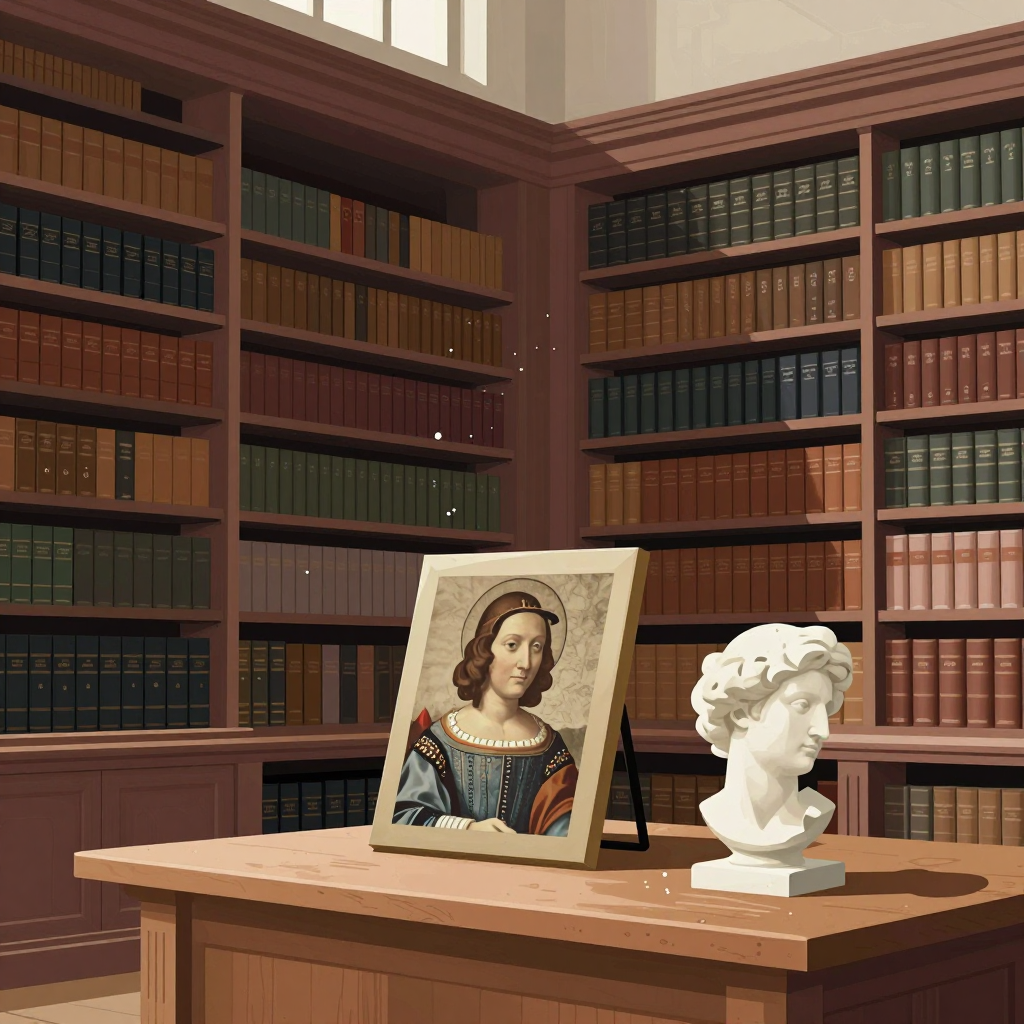
Recent studies reveal new insights into European art and history, from alabaster sculptures to Renaissance portraits and forgotten paintings.
Artists and regions studied
Recent academic publications have examined diverse aspects of European art and history, with scholars focusing on regions such as Poland, Ukraine, and Italy, among others. These studies span from medieval to early modern periods, highlighting a wide range of artistic and historical themes.Alabaster sculpture research
Aleksandra Lipińska, Uliana Naumenko, Tanita Ciesielska, Marek Walczak, and Wolfram Kloppmann have used isotopic fingerprinting to analyze the geography of late medieval and early modern alabaster sculpture in present-day Poland and Ukraine. This technique helps trace the origin of materials used in artworks.Mosaic decoration in San Marco
Bernát Rácz has examined the mosaic decoration of San Marco in Rome, focusing on Saint Mark the Evangelist. His study explores how this figure represents the papal perspective during the second iconoclastic controversy, which occurred between 814 and 842.Urban politics in a fresco
Dennis Romano has analyzed urban politics and topography in Guariento’s Coronation of the Virgin fresco. His work provides insight into how the political and spatial elements of the time were reflected in Renaissance art.Portrait of Charles VI
Dafna Nissim has investigated the cognitive and emotional agency of the portrait of Charles VI and his secular attendants in the Goldenes Rössl. Her study explores how such portraits influenced perceptions and interactions in their historical context.Moses Isserles’s likeness
Ilia M. Rodov has considered Moses Isserles’s elusive likeness in the context of modern European portraiture. His research highlights the challenges of identifying and interpreting historical figures in artistic depictions.Raphaelsque subject in Este collection
Lorenzo Boffadossi has discussed a Raphaelsque bacchic subject in the collection of the dukes d’Este. His analysis examines the stylistic influences and thematic elements of this artwork.Cinquecento portrait reconsidered
Roberta J. M. Olson and Joseph M. Silva have reconsidered an early Cinquecento Florentine portrait and its cover. Their work presents new documentary evidence and a biography of Caterina Antinori, offering fresh perspectives on the artwork and its context.Titian’s portrait in Copenhagen
James R. Jewitt has analyzed Titian’s early portrait of a man in Copenhagen. His study focuses on how the portrait depicts its subject as a Venetian gentleman in black, reflecting social and cultural norms of the time.Velázquez’s Las Meninas
Anthony Apesos has explored art theory and allusions to early Netherlandish painting in Velázquez’s Las Meninas. His research highlights the complex interplay of artistic influences and techniques in this iconic work.New Poussin painting discovered
Stephen Conrad has described a newly discovered early painting by Nicolas Poussin, Medea Restoring Aeson’s Youth. This finding adds to the understanding of Poussin’s early career and artistic development.Louis XIV’s France in art
Thomas Brown has examined the depiction of events in Louis XIV’s France through the lens of the state, market, and calendar. His analysis explores how these elements influenced the portrayal of historical events in art.Michelangelo’s Salting Hercules
Paul Joannides has looked at Michelangelo’s Salting Hercules and its siblings. His study considers their creation, context, and after-life, shedding light on the significance and evolution of these works over time.