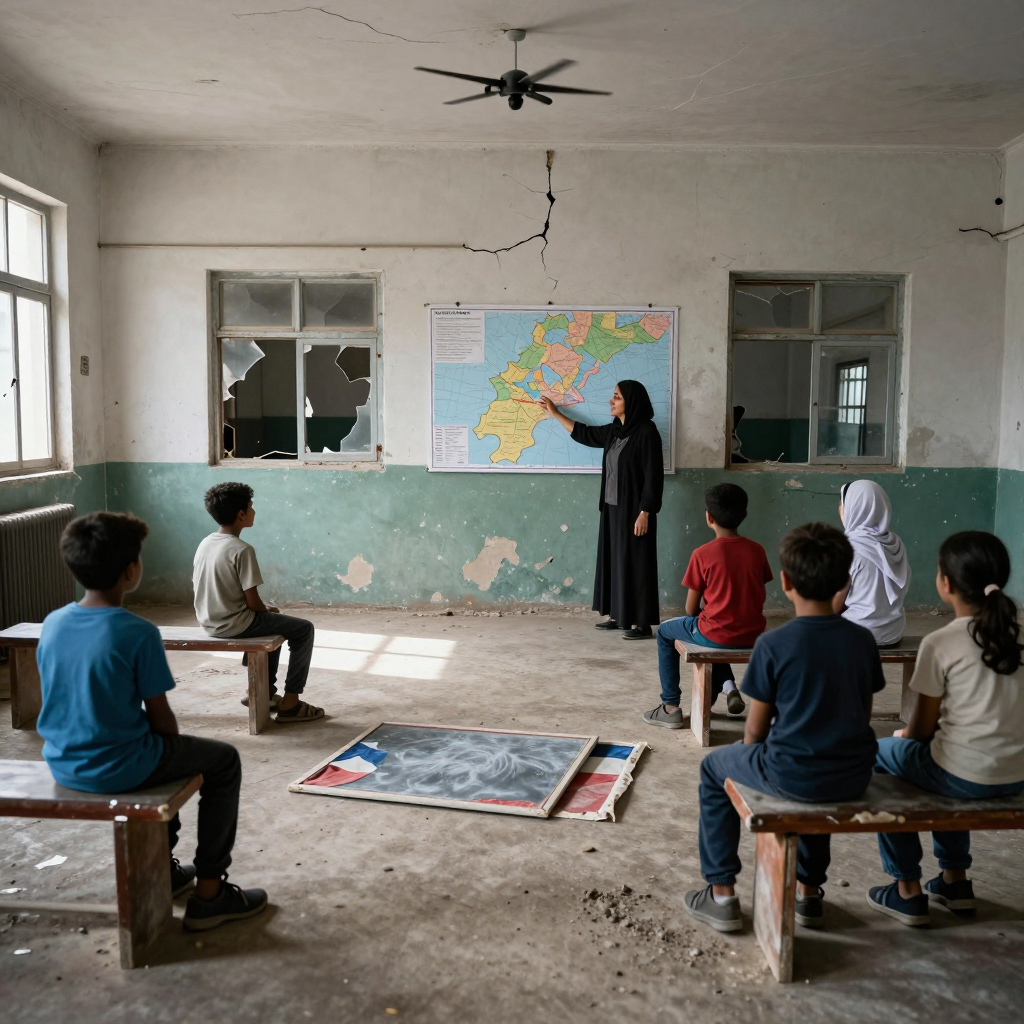
Hundreds of thousands of children in Gaza returned to in-person schooling on Saturday for the first time in nearly three years, gathering in damaged buildings, makeshift structures, and tents. The United Nations Children's Fund (UNICEF) reported that 98 percent of Gaza’s schools were destroyed or damaged during the recent conflict, leaving around 660,000 students without regular face-to-face education. The resumption of classes comes after a war that claimed the lives of about 22,000 students and over 770 educational staff, including 532 teachers, according to Ibrahim Ramadan, director of education in East Khan Younis.
The Gaza Ministry of Education, with support from local and international organizations, has launched the 2026-27 academic year by setting up dozens of temporary learning centers using materials like canvas, wood, metal sheets, and tents. Some of these makeshift classrooms are on bare sand, while others contain only a blackboard and a few mattresses. In some cases, these sites are still housing displaced families. Officials estimate that at least 540,000 students will attend in-person classes this year in temporary centers, makeshift private schools, and learning points supported by UNICEF. Students who cannot attend or live outside Gaza will continue with remote education.
Israeli forces continue to control more than 60 percent of Gaza, even though a ceasefire last year ended major fighting without fully resolving the conflict. Palestinian officials say over 73,000 people were killed during Israel's military operation, which began after Hamas-led militants killed about 1,200 people in southern Israel in October 2023. Khaled Aliyan, a 30-year-old stationery vendor, noted that Israeli import restrictions have limited the supply of school materials and driven up prices. "This notebook used to cost 3 shekels ($1), now it costs 15 shekels," he said. Israel’s COGAT military agency, which oversees the supply of goods to Gaza, did not respond to requests for comment on supply restrictions or attacks on educational sites. Israel has accused Hamas of using schools for military purposes, a claim Hamas denies.
For many students, the return to school is a mix of hope and hardship. Moayed Abu Mustafa, a student in Khan Younis, said he last attended school three years ago. "Now, we are starting the school year, it is a year of joy, happiness, and success," he said. Despite sitting on an unventilated tent floor without proper footwear, notebooks, or pens, and having lost friends in the war, he remains determined. "Despite all of this, we will learn, we will learn even in a tent," he said. Similarly, 15-year-old Samar Abu Salmi, who lives in a tent with her family, has resumed her education. "We studied on phones and we haven’t seen our teachers... now, we are back pursuing our dream... from one tent to another," she said. She added that essential items have become unaffordable since the war began.
Fourteen-year-old Yamen Abu Samra also attended class, recalling how school used to be a source of joy. "We used to wake up happy to go to school... Now, when we come to school, we’re afraid of stray bullets, rockets, strikes, everything," he said. He now sits in a tent with nothing but the sun and heat. "Now, I’m sitting in a tent that has absolutely nothing," he added, reflecting the harsh reality of education under ongoing conflict.
Gaza Students Resume In-Person Learning Amid Ongoing Conflict and Destruction
AI-rewritten from original reportingHow it works

gazaeducationwarchildrenconflictunicef