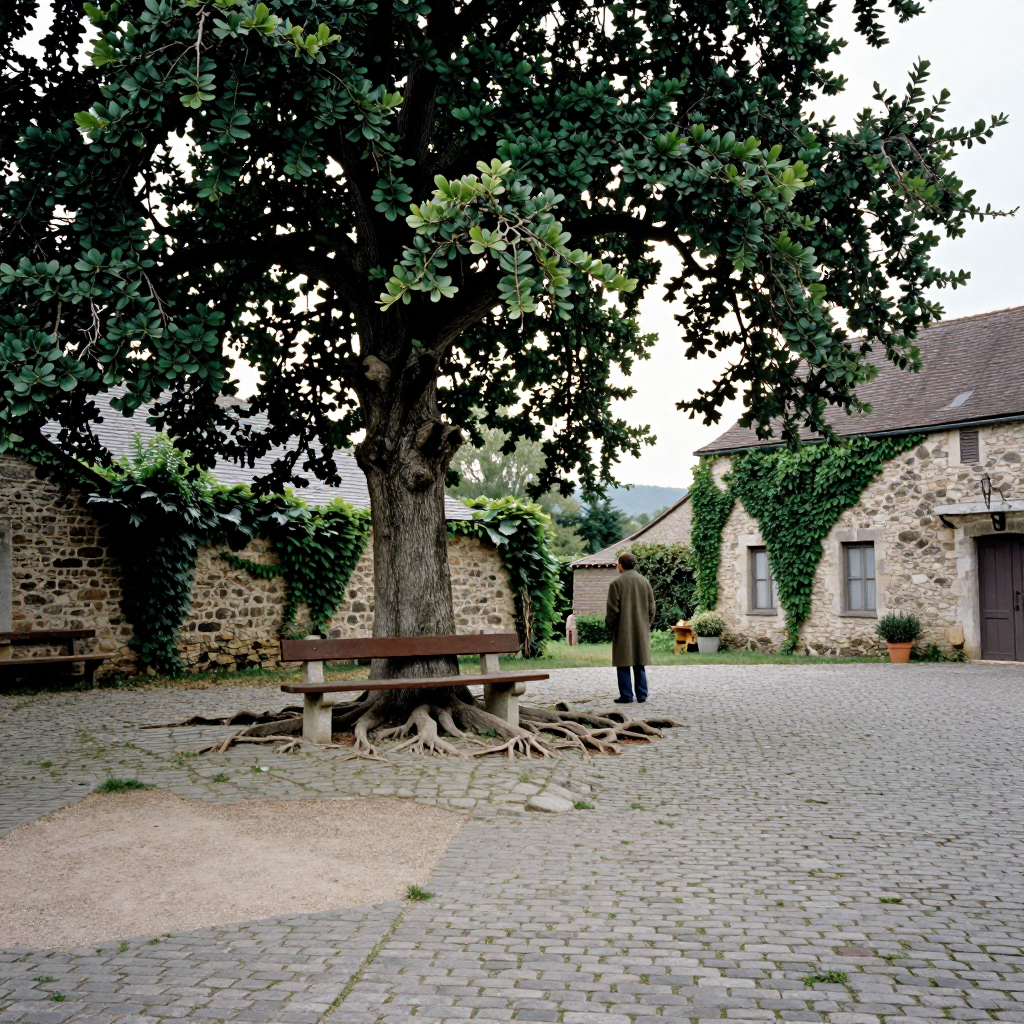
La maison du lac, a novel by Marius Loris Rodionoff, delves into both physical and emotional landscapes, exploring themes of childhood, memory, history, and a vanishing rural France. The story follows Lev, a young researcher in medieval history who abandons his academic life in search of stability and meaning. Written during a time of isolation, the novel is shaped by the author's limited movement, with its structure inspired by cherished places and topographic maps.
Lev, the grandson of Russian immigrants, embarks on a quest to find his grandparents' home, which symbolizes both a real location and a deeply personal center of gravity. His journey takes him through the Massif Central, from the Lozère to the Larzac, the Morvan to the Cévennes, and up to the Millevaches plateau, passing near the Léman region. His travel methods—walking, cycling, and using a makeshift canoe—reflect a personal philosophy of resistance against the conventional way of life.
The novel's landscapes, such as the Causses, the Cévennes, and the Millevaches plateau, are not just settings but places rich with memory. Lev’s travels also uncover historical layers, with the sites he visits marked by wars, memorials, and family legacies. His academic doubts mirror a broader disillusionment with knowledge, career, and the social systems that once seemed to offer meaning.
As Lev distances himself from Paris and the university, he sheds the certainties and social roles that defined his earlier life. This departure is marked by a rejection of emotional excess or dramatic flair, as Lev adopts a skeptical, combative attitude. He expresses a desire to challenge the "spirit of seriousness" by embracing randomness and chance.
The novel portrays a generation that no longer necessarily believes in the traditional promises of success but still seeks purpose. Lev’s journey is influenced by various forms of resistance he encounters, from the Yellow Vests movement to the "babos of the Vercors," highlighting alternative or marginalized aspects of French society. The novel’s strength lies in its dynamic language, blending scholarly and everyday elements with lyricism and irony. The landscape itself affects the rhythm and structure of the narrative, using associations and unexpected comparisons to create movement. Humor becomes a tool for resisting nihilism, as seen in Lev’s reflections on his academic past.
The novel concludes without clear answers, yet Lev finds peace in the possibility of continuing to walk, turning a journey into a form of resistance. La maison du lac is thus a landscape novel, a journey through French memory, and an ironic portrayal of a contemporary youth in conflict with institutions.
A Literary Journey Through Rural France and Personal Disillusionment
AI-rewritten from original reportingHow it works

literaturefrancememoryresistancelandscapenovel